
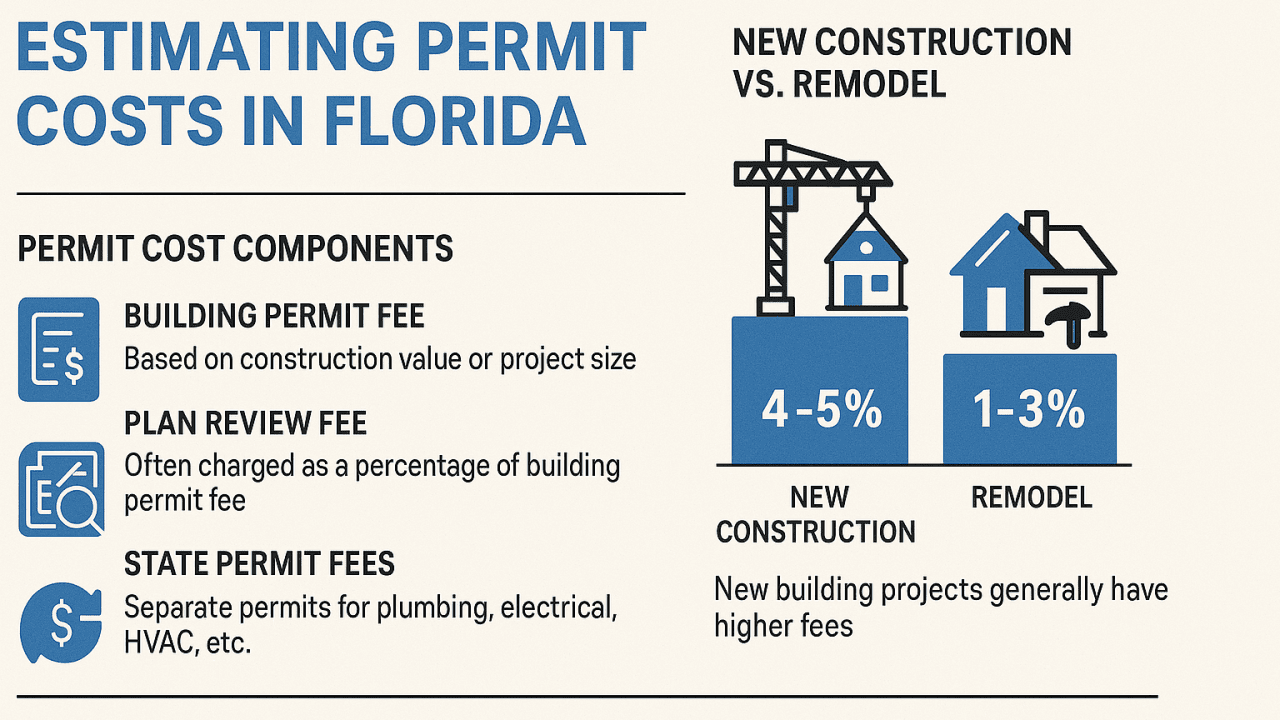
Building permit fees are a small but real part of most Texas repair and rebuild budgets, and they are easy to miss or misprice. Contractors bidding work, adjusters writing estimates, and attorneys evaluating property claims all need to account for them. This guide explains what permit costs usually include in Texas, which state laws shape how cities and counties may charge them, and practical ways to avoid underestimating them.
What “permit costs” usually include
Every Texas city sets its own fee schedule, so always check the local schedule for the project address. Common components include:
- Building permit fee for the primary work.
- Plan review fee, where the jurisdiction reviews drawings before issuing the permit.
- Trade permits for electrical, plumbing, mechanical, or gas work, unless the city bundles them.
- Re-inspection fees when an inspection fails or the site is not ready.
- Other local requirements, such as floodplain development permits, on-site sewage facility (septic) permits, or fire code permits.
Texas laws that shape residential permit fees
Cities may not price residential permits by value. Under Texas Local Government Code § 214.907, when a city sets a building permit or inspection fee for a residential dwelling, it may not consider the value of the dwelling or the cost of constructing or improving it. A city also may not require disclosure of that value or cost as a condition of the permit, except as required by FEMA for participation in the National Flood Insurance Program. The statute applies to residential dwellings; commercial fee schedules may still use valuation, so check the local rules.
Cities face a decision deadline. Local Government Code § 214.904 generally requires a city to grant or deny a covered building permit within 45 days of the application (or give written notice explaining why it cannot, or agree to a different deadline). If the city then misses that extended or agreed deadline, the statute bars it from collecting permit fees and requires it to refund fees already collected. Review the statute’s conditions before relying on it.
Residential code baseline. Local Government Code § 214.212 adopts the International Residential Code as the municipal residential building code, and cities may adopt local amendments and later editions. Knowing which edition and amendments a city has adopted matters when pricing code-required work.
Limits on local product bans. Texas Government Code § 3000.002 generally prohibits a governmental entity from banning a building product, material, or method allowed by a national model code published within the last three code cycles, subject to listed exceptions, including standards tied to windstorm insurance eligibility.
Counties are different
Texas counties generally do not have broad authority to require building permits for homes in unincorporated areas. Under Local Government Code chapter 233, subchapter F, a qualifying county that opts in may require new single-family homes and duplexes to meet the International Residential Code and to be inspected by qualified private inspectors, but the county’s ability to charge fees for that program is limited. A rural project may therefore have no county building permit fee, yet still need floodplain, septic, or fire code approvals and private inspection costs.
Coastal projects: windstorm certification
For property in the Texas Windstorm Insurance Association’s designated catastrophe area, Texas Insurance Code § 2210.251 generally requires construction, alterations, and repairs, including re-roofs, to comply with the applicable building standards for the structure to be insurable through TWIA. The Texas Department of Insurance issues the Certificate of Compliance (Form WPI-8-E) for completed work. Engineering and inspection costs to obtain that certificate belong in coastal estimates.
New construction vs. repairs
New construction typically involves more fee categories than a repair, including plan review, multiple trade permits, and utility or development charges. Repairs and replacements may need only a single permit, or none, depending on the city and the scope. Many Texas cities require a permit for a full roof replacement, but requirements vary, so confirm with the building department before assuming either way.
Common estimating mistakes
- Leaving out trade permits or re-inspection fees.
- Using an outdated fee schedule.
- Applying a valuation-based formula to residential work in a city where § 214.907 prohibits it.
- Assuming a rural project needs no approvals at all.
- Forgetting windstorm inspection and certification costs on the coast.
Permit costs in insurance claims
When a covered repair legally requires a permit, replacement-cost estimates commonly include the permit fee as a line item. Whether permit fees and code-upgrade costs are paid, and in what amount, depends on the policy language, including any ordinance-or-law coverage and its limits. Wording matters: in JAW The Pointe, L.L.C. v. Lexington Insurance Co., 460 S.W.3d 597 (Tex. 2015), the Supreme Court of Texas held that anti-concurrent-causation language barred coverage for code-upgrade costs where excluded flood contributed to the loss along with covered wind.
Practical tips: print or save the city’s permit requirement for the scope of work, keep the permit application and receipt, list permit and inspection fees as separate estimate line items, and keep copies of the adopted code provisions that drive any upgrade costs.
Bottom line
Permit costs vary by city, county, and scope, and several Texas statutes limit how local governments can charge them. Check the local schedule for every project, document it, and carry it through the estimate.
Related reading
Texas authority referenced
- Tex. Local Gov’t Code § 214.907 (residential permit and inspection fees; value and cost may not be considered)
- Tex. Local Gov’t Code § 214.904 (deadline for city permit decisions; fee consequences)
- Tex. Local Gov’t Code § 214.212 (International Residential Code as municipal residential building code)
- Tex. Local Gov’t Code ch. 233, subch. F (county residential building code standards)
- Tex. Gov’t Code § 3000.002 (limits on local regulation of building products, materials, and methods)
- Tex. Ins. Code § 2210.251 (TWIA building-standard compliance; Certificate of Compliance)
- JAW The Pointe, L.L.C. v. Lexington Ins. Co., 460 S.W.3d 597 (Tex. 2015)
This article is general information for contractors, adjusters, attorneys, and property owners. It is not legal advice, and reading it does not create an attorney-client relationship. Statutes and local fee schedules change; confirm current requirements with the building department and the official statutes before relying on them. Michael P. Bowman is licensed to practice law in Texas and Alabama.


